Ask a Texas hospital how things are going and you will hear about new hires, ribbon cuttings, and awards. Ask a Texas patient and you will hear about bills, waits, and closed facilities. Both are telling the truth. The striking part is how far apart the two stories sit, and that the distance is growing.
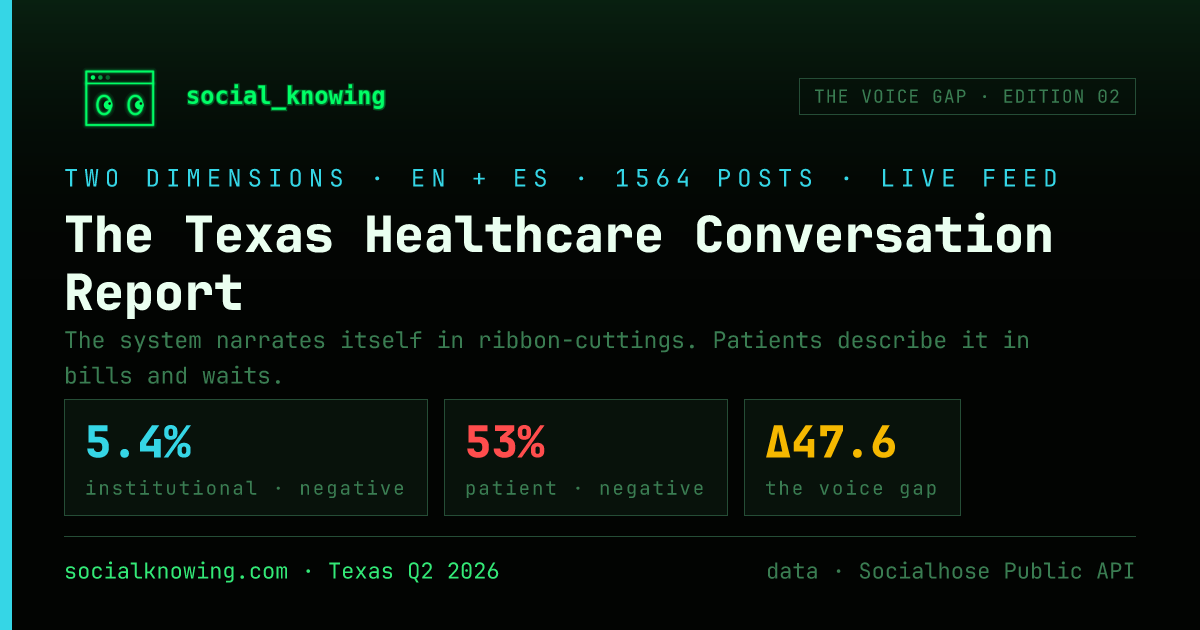
That distance now has a number. The Texas Healthcare Conversation Report (Edition 02), published by Social Knowing, our independent research journal, analyzed 13 weeks of public social posts about Texas healthcare (April 1 through June 30, 2026) and measured what it calls the Voice Gap: the difference in sentiment between posts from healthcare institutions and posts from patients describing their own care.
The headline: a 47.6-point gap, and widening #
Across 1,564 analyzed posts, institutional accounts ran 78% positive and just 5% negative. Patient posts ran 53% negative, dominated by accounts of cost, coverage denials, long waits, and facility closures. That puts the Voice Gap at 47.6 points for the quarter.
It is not a static number. Measured week by week, the gap widened by 10.4 points between the opening of the quarter and its close. The two descriptions of the same system are moving further apart, not converging.
They are not even talking about the same things #
The gap is not just about tone. It is about subject matter:
Cost and coverage lead patient posts at 22%, and patients account for 39% of all cost-themed posts in the sample.
Access and closures account for another 11% of patient posts.
Institutional accounts post mostly about their own hiring (7%) and openings (4%), and rarely address the topics patients raise most often.
Patients also simply talk about the system more than the system talks about itself: patient posts make up 24% of the healthcare conversation, institutional posts just 5%.
The Spanish-language conversation is its own channel #
One finding deserves more attention than it usually gets: 16% of the analyzed posts fall under Spanish-language service topics such as appointments, vaccines, and access, and 52% of those posts are negative. The report reads this as a separate access channel with its own concerns, not a translation of the English conversation. If your monitoring is English-only, you are missing a meaningful and distinctly unhappy slice of the Texas healthcare conversation.
Why this matters beyond Texas healthcare #
"We don't treat the patient side as a correction of what hospitals say about themselves," says Socialhose founder Mo Elzubeir. "Hospitals really are hiring and opening new facilities, and patients really are dealing with bills, long waits, and closures. Both are accurate descriptions of the same system. What we track is how far apart they sit, and this quarter they moved further apart."
That framing applies to any organization. Your official channels tell one story; your customers tell another. Neither is false. But the size of the gap between them, and its direction of travel, is one of the most honest indicators of reputational risk you can measure. A widening gap means the institutional story is losing its audience.
How the numbers were built #
All figures come from the Socialhose Public API, the same feed that powers the always-on TX Health Monitor. Posts were sampled evenly across the 13-week window, then classified by voice (institutional, patient, policy and press), theme, sentiment, and Spanish-service topic. Published figures are frozen at publication; the live board carries the current reading between editions, tracking 412 bilingual keywords across four statewide verticals and five metros.
Between editions, the monitor keeps surfacing what moves. Right now that includes the GLP-1 drug conversation (Ozempic, Wegovy, Mounjaro and peers) as the highest-velocity drug story in healthcare, and continued rapid growth in Spanish-language patient experience content.
Read the report #
Read the full Texas Healthcare Conversation Report (Edition 02), including the complete methodology and the voice-by-theme matrix, or check the current reading on the TX Health Monitor. And if you want to measure the voice gap in your own market, the same instrument is available through the Socialhose platform and Public API.